We arrived early at Quarry Bank and looked round before anything was open. This old cotton mill was run by the Greg family in the Bollin valley in Cheshire - just one their mills. The River Bollin turned the huge waterwheel that drove the first machines on this site before they converted to steam. That wheel is still working.
At 11am we got our tickets and crossed a bridge into the factory. The first floor was fairly empty - undergoing a revamp. Part of it was being prepared for the children's activities.
But we could hear the thump of the machines down below. First we saw the carding, and spinning machines. Then a lady showed us the same process on earlier wooden machines: from carding through spinning to weaving - first with a hand moved shuttle, then a faster flying shuttle.
After that we came into the largest machine room (showed above) where a volunteer had four weaving machines going together.
There was then a lot of history displays, but we had to dash to get to the apprentice's house for a booked tour at 12:15 to learn how these children lived.
The children worked 12 hour days in the mill, 13 as punishment if they were a minute late. Then had an hours schooling from 8-9pm. Mr Greg's wife was a Unitarian and made sure the girls also learned to read and write, not just the boys. Some of the detail of their lives came from two boys who ran home to London to see their mum.
The government were gradually tightening up on the hours of child labour, and eventually the apprentice house was closed down. The guide gave a very interesting, animated talk - accentuating some of the horrible history for the children in our audience. The children's lives in those days was very hard. They were picked for being fit and given a medical before starting. Many came from the workhouse. After a trial period, to make sure they were good workers, they could sign up for anything from 2 to 10 years. In return for work they got the board and lodging.
There are also some beautiful gardens at Quarry Bank, with recently restored glass houses, and waterside walks, and some houses to view in the workers village .
The National Trust were also restoring the Greg family home, to be re-opened in September, and building a new visitor centre.
Friday, August 11, 2017
Thursday, August 10, 2017
Dunham Massey
We passed a 500 year old Oak Tree on the path from the Carpark to the grounds and Manor House of Dunham Massey in Cheshire. It had seen a lot of changes on that site.
Inside we were given a tour and shown some of the owners of houses on this site. The earliest picture was of old Sir George Booth who rebuilt the house in the late 16th century, and then his grandson, young George Booth (above), who fought first on the side of Oliver Cromwell, and then deciding the new regime had got things wrong, on the royalist side. He got sent to the Tower of London until the restoration of the Monarchy under Charles II.
The present house was mostly built in 1770s, and then abandoned by the 7th Earl of Stamford in Victorian times, and that was the story the national Trust are telling this season - as a family attraction.
The Earl took for his second wife a circus performer called Catherine. The Cheshire set were against this marriage, as was Queen Victoria. Feeling rejected, the Earl and Catherine abandoned their house in Cheshire, taking some treasures with them, to their other 2 houses.
Outside children had a carnival theme with performers and tents to learn about Catherine's circus life, and inside they could discover more of what happened when the Earl left.
The downstairs servants area, with a cook, milk maid, and wash maid brings the place to life.
The 9th Earl of Stamford moved the family back to Dunham Massey and set about trying to create a grand house with a new elaborate front entrance. He was not altogether pleased with the result and fired the architect. Perhaps he wanted it even grander.
On his death in 1910 the house was given to his son Roger, the 10th Earl of Stamford, who tried to recover some of the former possessions of the house, including a Grinling Gibbons wood carved crucifixion seen in the library. He left it all to the National Trust.
Inside we were given a tour and shown some of the owners of houses on this site. The earliest picture was of old Sir George Booth who rebuilt the house in the late 16th century, and then his grandson, young George Booth (above), who fought first on the side of Oliver Cromwell, and then deciding the new regime had got things wrong, on the royalist side. He got sent to the Tower of London until the restoration of the Monarchy under Charles II.
The present house was mostly built in 1770s, and then abandoned by the 7th Earl of Stamford in Victorian times, and that was the story the national Trust are telling this season - as a family attraction.
The Earl took for his second wife a circus performer called Catherine. The Cheshire set were against this marriage, as was Queen Victoria. Feeling rejected, the Earl and Catherine abandoned their house in Cheshire, taking some treasures with them, to their other 2 houses.
Outside children had a carnival theme with performers and tents to learn about Catherine's circus life, and inside they could discover more of what happened when the Earl left.
The downstairs servants area, with a cook, milk maid, and wash maid brings the place to life.
The 9th Earl of Stamford moved the family back to Dunham Massey and set about trying to create a grand house with a new elaborate front entrance. He was not altogether pleased with the result and fired the architect. Perhaps he wanted it even grander.
On his death in 1910 the house was given to his son Roger, the 10th Earl of Stamford, who tried to recover some of the former possessions of the house, including a Grinling Gibbons wood carved crucifixion seen in the library. He left it all to the National Trust.
Tuesday, August 08, 2017
Little Moreton Hall
We walked round Little Moreton Hall, a tudor timbered building, for the first hour, and then joined in one of the guided tours.
The building, situated in Cheshire, just south of Congleton, was clearly amazing, and the guide added to that with his enthusiasm and knowledge, taking us from the first building of the great hall in tudor times by Thomas Moreton, and how it got enlarged by his son and grandson, great entrepreneurs in the area. The family were royalists and lost a lot of their land during the English Civil war, and the hall was rented out to tenant farmers until Victorian times, when Sister Elizabeth Moreton took possession and set about restoring it.
There are recent discoveries such as the wall painting showing the story of Susanna and the Elders from the apocrypha.This is a unique collection of pictures like a medieval comic strip with the top missing.
"There was a man living in Babylon whose name was Jo′akim. 2 And he took a wife named Susanna, the daughter of Hilki′ah, a very beautiful woman and one who feared the Lord... (story continued)
The building, situated in Cheshire, just south of Congleton, was clearly amazing, and the guide added to that with his enthusiasm and knowledge, taking us from the first building of the great hall in tudor times by Thomas Moreton, and how it got enlarged by his son and grandson, great entrepreneurs in the area. The family were royalists and lost a lot of their land during the English Civil war, and the hall was rented out to tenant farmers until Victorian times, when Sister Elizabeth Moreton took possession and set about restoring it.
"There was a man living in Babylon whose name was Jo′akim. 2 And he took a wife named Susanna, the daughter of Hilki′ah, a very beautiful woman and one who feared the Lord... (story continued)
Warwick
Warwick Castle is not that far from us. We wished we had visited years ago when our children were young. Most of the visitors were young families, but it still has a lot for us oldies. Climbing the ramparts was exciting and gave some wonderful views.
The eagles flying display was the best falconry display I had ever seen. The falconer gave a great commentary. It brought tears to my eyes to see some of the birds fly - very moving.
We queued up with others to watch the War of the Roses between Yorkists, and Lancastrians. Some great riding and theatricality and a chance to relearn some history. Added to the drama was the team rivalry - half the crowd cheered for the whites and half for the reds.
The River running beneath the castle is a vision ...
as are parts of the town beyond the castle.
The eagles flying display was the best falconry display I had ever seen. The falconer gave a great commentary. It brought tears to my eyes to see some of the birds fly - very moving.
The River running beneath the castle is a vision ...
as are parts of the town beyond the castle.
Thursday, April 13, 2017
Beverley Minster
A few miles north of Hull is the town of Beverley.
What is quite remarkable is that there has been a religious building on the same spot in Beverley since St John of Beverley founded a monastery there around 700 AD.
Work on the present church began around 1220, and took about 200 years to complete.

Beverley Minster became a mixture of Gothic styles with a splendid perpendicular Gothic nave.

We visited on Maundy Thursday a few hours before the Holy Communion service.

In one chapel was a cross with just a carved out space instead of a body.
In the neighbouring Percy Chapel, above the magnificent Percy Tomb, is a flag that shows the decay of years.
What is quite remarkable is that there has been a religious building on the same spot in Beverley since St John of Beverley founded a monastery there around 700 AD.
Work on the present church began around 1220, and took about 200 years to complete.

Beverley Minster became a mixture of Gothic styles with a splendid perpendicular Gothic nave.

We visited on Maundy Thursday a few hours before the Holy Communion service.

In one chapel was a cross with just a carved out space instead of a body.

In the neighbouring Percy Chapel, above the magnificent Percy Tomb, is a flag that shows the decay of years.
Wednesday, April 12, 2017
Hull - The Humber Bridge
We didn't manage to get tickets for the Height of the Reeds sound journey where people walk over the Humber Bridge with headphones. That seems to be at the weekends anyway, and was sold out during April.
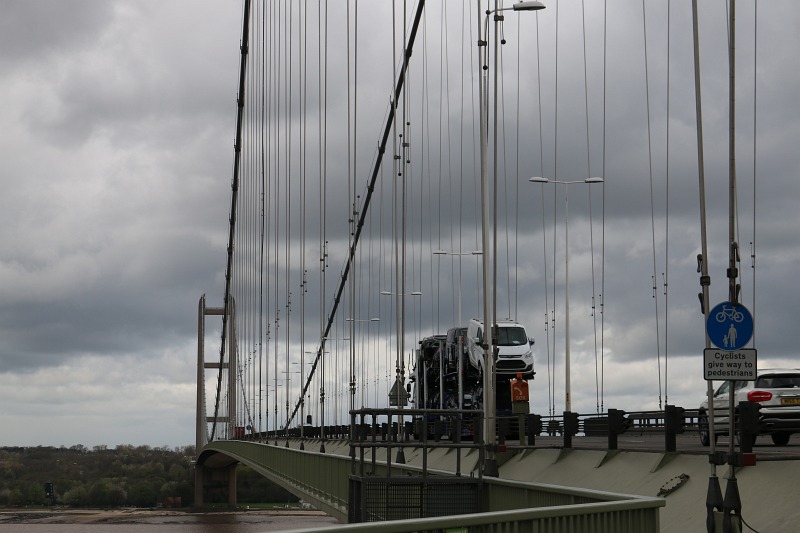
Instead we drove from Hull and parked the car near the visitor centre at Hessle, then crossed the Humber Bridge towards Lincolnshire under a grey sky. The wind was strong particularly near the large towers.
The wind was still strong on the walk back over the Humber Bridge, but the sky had brightened and there was some sun. Lovely! No need to go round by Goole.
My wife remembered exploring Hessle Foreshore in the sixties, and picking up bits of pottery. That was before the bridge was properly planned. Back then they sang ...
"Will they ever bridge the Humber? Will they ever span it o'er?
Is it always an exception to the rule?
Is it such a privilege to have a Humber Bridge?
Do we have to keep on going round by Goole?"
Instead we drove from Hull and parked the car near the visitor centre at Hessle, then crossed the Humber Bridge towards Lincolnshire under a grey sky. The wind was strong particularly near the large towers.
After coffees in a pub called The Sloop, in Barton, we walked to a viewing point where there were reeds.
We then walked under the bridge on the Viking Way.
My wife remembered exploring Hessle Foreshore in the sixties, and picking up bits of pottery. That was before the bridge was properly planned. Back then they sang ...
"Will they ever bridge the Humber? Will they ever span it o'er?
Is it always an exception to the rule?
Is it such a privilege to have a Humber Bridge?
Do we have to keep on going round by Goole?"
Tuesday, April 11, 2017
Hull - Real and Surprising Flowers
During 2017 Hull is the UK City of Culture. The Queens Gardens in Hull is full of real flowers. Not all the flowers on display elsewhere are real ...
Daffodils in King Edward Square are made of lego bricks,
and from a window in the tower of the Maritime Museum cascade ceramic poppies.
Daffodils in King Edward Square are made of lego bricks,
and from a window in the tower of the Maritime Museum cascade ceramic poppies.
Sunday, August 07, 2016
Join the Rising

The Sinn Féin shop in Dublin is one of many places in Ireland celebrating the centenary of the 1916 Easter Uprising, and eventual independence from Great Britain in 1922. You can get your 100th Anniversary T Shirt, or 101 Songs of Irish Rebellion - the 5CD Set, or 100th Anniversary mug.

The 1916 Proclamation is also on sale, and is to be seen in many shops around Ireland.The one above is not for sale, being one of the few originals that survive. It is on display not far from the Book of Kells in the Library of Trinity College, Dublin.
Friday, August 05, 2016
Gleninchaquin Park
Our walk started at the foot of the waterfall, and followed a rocky trail to an upland lake that feeds the waterfall, then back down through more sheep, and beside a shady woodland river.
Tuesday, August 02, 2016
Bere Island Ferry

We visited Castletownbere, a 19th Century port built for the Allihais copper mines across the peninsular. There were large fishing boats on the wharf being prepared for their next voyage, and a ferry to Bere Island. We caught the ferry at 1:30. A dozen or so people touring on bikes, and pedestrians, got on first. Many of the pedestrians had loads of shopping from the nearby Supervalu supermarket. Their cars were waiting on the other side. Next a man drove up with a fork lift to unload a large empty rectangular cage. He then maneuvered a cherry picker off the ferry. That gave enough room for 4 cars to reverse onto the ferry. It was a tight squeeze with passengers directing the cars.
Subscribe to:
Posts (Atom)